
WELCOME BONUS 300%
UP TO €2000 + 100
FREE SPINS
UP TO €2000 + 100
FREE SPINS
Home → Roulette
Roulette at Slottica-Casino
2.70 vs 5.26 Percent House Edge
European Roulette offers a house edge of 2.70% on all bets due to its single zero and 37 sectors, a distinct advantage when compared to American Roulette. The American variant, with its additional double zero, presents a significantly higher house edge of 5.26%. This difference means that for every 100 units wagered, European Roulette theoretically returns 97.30 units, while American Roulette returns only 94.74 units.
The house advantage on European Roulette remains consistent across all bet types, including the straight bet paying 35:1. In contrast, American Roulette features a specific 'Five Number Bet' with an even steeper house edge of 7.89%, covering five sectors for a 6:1 payout. This particular bet on the American wheel is notably worse than the standard 5.26% edge found on other bets.
Players seeking a more favourable mathematical proposition in roulette will find European Roulette's 2.70% house edge more appealing than the 5.26% edge presented by its American counterpart. This disparity is a direct consequence of the number of pockets on the wheel, with the single zero in European Roulette significantly reducing the house's statistical advantage over the long term.
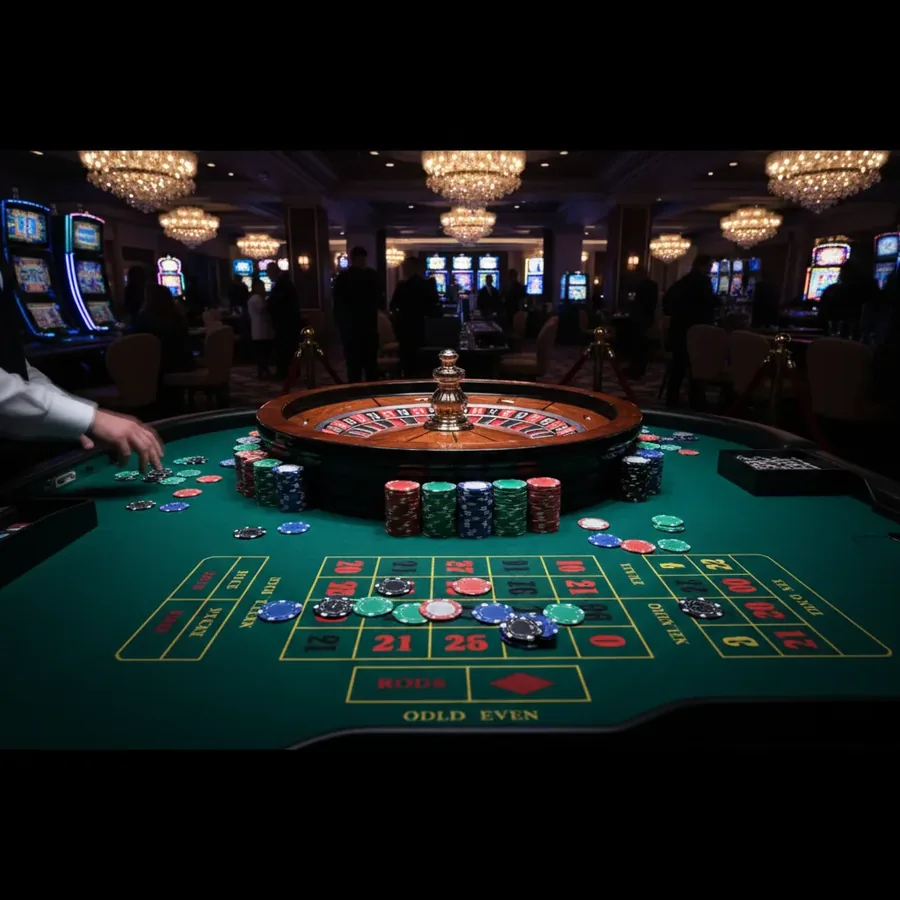
100 Euro Bankroll: 100 Rounds Simple Chances
With a 100 Euro bankroll, playing simple chances in European Roulette, specifically bets like red/black or odd/even, allows for approximately 100 rounds of play if no wins occur and all bets are placed at 1 Euro. These bets offer a 1:1 payout and are part of the 2.70% house edge inherent in European Roulette. This calculation assumes a consistent bet size for each round.
The theoretical RTP of European Roulette stands at 97.30%, meaning over an extended period, 97.30% of all wagers are returned to players. For a 100 Euro bankroll, this translates to a theoretical return of 97.30 Euros after 100 rounds of 1 Euro simple chance bets, assuming the house edge consistently applies.
Playing 100 rounds on simple chances with a 100 Euro bankroll at 1 Euro per round highlights the frequency of play possible. Each round on European Roulette, with its 37 sectors and consistent 2.70% house edge, offers a defined statistical outcome for player funds over time.
La Partage: What 50 Percent Return Means
The La Partage rule in French Roulette significantly benefits players by offering a 50 percent return of the stake on even-money bets when the ball lands on zero. This rule effectively halves the house edge on these specific bets, reducing it from 2.70% to an advantageous 1.35%. The benefit is directly tied to bets like red/black or odd/even.
When the zero appears, a 1 Euro bet on red/black in French Roulette with La Partage would see 0.50 Euros returned to the player, representing a 50 percent recovery of the initial stake. This contrasts sharply with European Roulette, where a zero spin on an even-money bet would result in the loss of the entire 1 Euro stake.
The presence of La Partage on French Roulette's even-money bets provides a tangible benefit, offering a 50 percent partial refund under specific conditions. This rule is exclusive to French Roulette and does not apply to inside bets, which retain the standard 2.70% house edge found on European Roulette.
How Long is a Betting Phase at a Live Table?
Live roulette tables, such as Auto Roulette Classic 1 Live by Authentic Gaming, typically have defined betting phases that allow players to place wagers before the outcome is determined. While specific durations can vary, these phases are generally short, accommodating the rapid pace of live dealer games. The betting phase is crucial for placing bets before the ball is released.
Games like XXXtreme Lightning Roulette and Lightning Roulette, offered by Evolution, feature dynamic betting phases where players can place bets on numbers that may receive special multipliers. These multipliers can significantly increase potential payouts on straight bets, up to 2,000x in XXXtreme Lightning Roulette. The betting window is designed to allow for these strategic choices.
The duration of a betting phase at a live roulette table is a critical element of the gameplay, influencing how players strategize and place their bets. For instance, on Auto Roulette Classic 1 Live, players have a limited time to select their numbers before the automated wheel spins, underscoring the importance of quick decision-making.
Small Budget: Why Straight 35:1 Empties Quickly
A small budget can be depleted rapidly when consistently betting on the straight 35:1 payout in roulette, especially on a European or French wheel with 37 sectors. A single 1 Euro bet on a straight number, if it loses, results in the entire 1 Euro being lost, leaving only 99 Euros from an initial 100 Euro bankroll.
The high payout ratio of 35:1 for a straight bet means that a win is infrequent relative to the number of possible outcomes on a 37-sector wheel. For a 1 Euro bet, a loss means the full amount is gone, whereas a win would return 36 Euros (35:1 payout plus the original 1 Euro stake). This risk-reward dynamic makes consistent betting challenging on a small budget.
When playing with a limited bankroll, such as 100 Euros, focusing on bets with lower payouts but higher probabilities, like even chances (1:1 payout), is generally more sustainable. The straight 35:1 bet, while offering the highest potential return on a single number, carries a higher risk of quickly exhausting a small budget due to the frequency of losing spins.
Roulette bet types at a glance
| Bet | Payout | Win Chance | Numbers Covered | House Edge |
|---|---|---|---|---|
| Roulette Amerikanisch – Five Number Bet (0, 00, 1, 2, 3) | Five Number 6:1 (deckt 5 von 38 Sektoren) | 92.11% | Einzige Wette am amerikanischen Rad mit Edge über 5,26% – „Fallenwette“. Kein Äquivalent am europäischen Rad | 7.89% |
| Roulette Amerikanisch (doppelte Null, 38 Sektoren) | Straight 35:1, Split 17:1, Street 11:1, Corner 8:1, Six Line 5:1, Dozen 2:1, Column 2:1, Rot/Schwarz 1:1 | 94.74% | 38 Sektoren (1–36 + 0 + 00); Auszahlungen wie beim europäischen Rad, aber der zusätzliche Sektor verdoppelt den Hausvorteil | 5.26% |
| Roulette Französisch mit La Partage (gerade Chancen) | Rot/Schwarz 1:1 (bei 0 Rückerstattung 50%), Odd/Even 1:1, Low/High 1:1; Innere Einsätze ohne La Partage: Straight 35:1, Split 17:1, Street 11:1, Corner 8:1 | 98.65% | Bei 0 wird die Hälfte des Einsatzes auf gerade Chancen zurückerstattet (Rot/Schwarz, Pair/Impair, Manque/Passe). En Prison gibt denselben 1,35%. Regel gilt NUR für gleiche Einsätze | 1.35% |
| Roulette Europäisch (einfache Null, 37 Sektoren) | Straight 35:1, Split 17:1, Street 11:1, Corner 8:1, Six Line 5:1, Dozen 2:1, Column 2:1, Rot/Schwarz 1:1, Odd/Even 1:1, 1-18/19-36 1:1 | 97.30% | 37 Sektoren (1–36 + 0); Auszahlungen wie für 36 Sektoren – daher konstanter Edge auf ALLE Wetten | 2.70% |
| Roulette Französisch, innere Einsätze (La Partage gilt nicht) | Straight 35:1, Split 17:1, Street 11:1, Corner 8:1, Six Line 5:1, Dozen 2:1, Column 2:1 | 97.30% | Rad gleich (37 Sektoren), aber La Partage/En Prison gilt nicht für innere Einsätze – Edge bleibt europäisch | 2.70% |
European or American: Which Wheel Pays Better
The European Roulette wheel features 37 sectors, offering an RTP of 97.30% and a house edge of 2.70%. This contrasts with the American Roulette wheel's 38 sectors, which includes a double zero, resulting in a lower RTP of 94.74% and a significantly higher house edge of 5.26%.
While both wheels might offer a 35:1 payout on a straight bet, the additional sector on the American wheel drastically increases the house's advantage. For instance, a straight bet on American Roulette has a house edge of 5.26%, whereas the same bet on European Roulette is only 2.70%.
This difference means players opting for European or French Roulette generally face more favourable odds. The reduced house edge translates to a potentially better return over time, making it the preferred choice for those prioritizing optimal payout rates.
La Partage Applies Only to Even Chances
French Roulette, specifically when employing the La Partage rule, offers a distinct advantage on even-chance bets such as Red/Black or Odd/Even. The RTP for these bets under La Partage conditions can rise to 98.65%, reducing the house edge to a mere 1.35%.
This favourable rule, however, is exclusively reserved for even chances; inside bets on the French wheel do not benefit from La Partage. A straight bet on French Roulette without La Partage still yields a 97.30% RTP and a 2.70% house edge, mirroring standard European rules for these wagers.
Therefore, players focused on maximizing returns on simple bets should specifically seek out French Roulette tables where La Partage is active. The distinction is crucial, as internal bets, despite being on the same wheel, do not qualify for the halved loss on zero.
When is it Worth Switching to French Roulette?
Switching to French Roulette becomes particularly worthwhile when pursuing strategies that involve frequent bets on even chances, such as Red/Black or Odd/Even. The presence of the La Partage rule, which refunds half the stake on a zero outcome for these bets, effectively lowers the house edge to 1.35%.
This reduction in the house edge, from 2.70% on standard European Roulette to 1.35% on French Roulette with La Partage for even chances, significantly impacts long-term play. The RTP for these specific bets climbs to 98.65%, offering a more player-friendly environment compared to other variants.
While standard inside bets on French Roulette still carry a 2.70% house edge, the benefit on even chances is substantial. For players aiming to mitigate losses during streaks of zero outcomes on their outside bets, French Roulette presents a clear strategic advantage.
Why the Ball Has No Memory
The concept of 'the ball has no memory' is fundamental to understanding roulette probabilities, particularly in comparison to variants like American Roulette. Each spin of the wheel is an independent event, meaning past outcomes have absolutely no bearing on future results.
For example, the European Roulette wheel, with its 37 sectors and 2.70% house edge, functions on this principle. Whether red has appeared ten times in a row or zero has landed consecutively, the odds for the next spin remain constant for any given bet.
This independence is crucial when comparing it to the American variant, which has a 5.26% house edge due to the additional '00' sector. The presence of this extra pocket does not influence the likelihood of any specific number appearing on subsequent spins, but it does alter the overall probabilities.
La Partage Halves Loss on Zero
The La Partage rule, a key feature of French Roulette, directly impacts the player's experience by reducing losses on zero outcomes for even-chance bets. When the ball lands on zero during a bet on Red/Black, Odd/Even, or Low/High, half of the stake is returned to the player.
This rule significantly enhances the return to player (RTP) for these specific bets, pushing it to 98.65% and consequently lowering the house edge to 1.35%. This is a marked improvement compared to standard European Roulette, where the house edge on even chances remains 2.70%.
For example, a €10 bet on Red in French Roulette with La Partage would result in a €5 refund if the ball lands on zero, rather than the entire €10 being lost. This mechanic only applies to even chances, not inside bets, which retain their standard payouts and house edge.
House Edge 2.70 Percent in One Number
European Roulette offers a house edge of 2.70% on a 37-sector wheel with a single zero. This contrasts with American Roulette, which features a double zero and a higher house edge of 5.26% across its 38 sectors. While payouts for standard bets like Straight are the same at 35:1, the additional sector on the American version significantly increases the casino's advantage.
This 2.70% house edge applies consistently across all bets on the European wheel, including even-money bets such as Red/Black, Odd/Even, and 1-18/19-36, which all pay 1:1. Unlike some other variants, the European layout does not introduce special rules that alter this edge for specific bet types, maintaining a predictable statistical advantage.
For players seeking to minimize the casino's advantage, understanding this fundamental difference is crucial. Opting for European Roulette over its American counterpart, where available, can lead to a statistically more favorable outcome over extended play due to the lower house edge.
How Lightning Roulette Draws 1 to 5 Numbers
Evolution's XXXtreme Lightning Roulette enhances the classic game with multipliers, potentially impacting up to 10 numbers per round. This variant, like its predecessor Lightning Roulette, features a standard 37-sector European wheel but adds a dynamic multiplier element that can significantly increase payouts on straight-up bets.
Lightning Roulette offers multipliers ranging from 50x to 500x on 1 to 5 "Lightning Numbers" selected each round, adding an exciting layer of unpredictability. While the base RTP remains at 97.30%, these random multipliers can dramatically alter the potential returns on individual bets.
The core payouts remain consistent with European Roulette, such as a 35:1 for a Straight bet, but the potential for amplified wins through the lightning feature distinguishes these live dealer variations. Players should be aware that these multipliers are applied randomly to specific numbers chosen by the game.
Place Chip Until Rien ne va plus
In live dealer roulette, such as Auto Roulette Classic 1 Live by Authentic Gaming, players can place chips until the croupier announces 'Rien ne va plus,' signaling the end of betting. This traditional phrase, meaning 'nothing goes anymore,' indicates that all bets are final and the wheel is about to be spun.
The Auto Roulette Classic 1 Live operates on a standard 37-sector European wheel, offering an RTP of 97.30%. Bets can range from 0.10 EUR up to 2,000 EUR, accommodating a wide spectrum of player budgets and betting strategies. The game aims to replicate the experience of a physical casino.
Understanding the betting window, from the opening of the table to the 'Rien ne va plus' call, is fundamental to live roulette play. This period allows players to strategize and place their chosen wagers before the outcome is determined by the spinning wheel.
Corner 8:1 Covers Four Numbers
A Corner bet, also known as a Square bet, covers four adjacent numbers on the roulette layout and pays out at 8:1. This bet type is available on various roulette games, including European and American variants, offering a different risk-reward profile compared to other wagers.
While European and French Roulette wheels have 37 sectors, American Roulette has 38 due to the double zero. Regardless of the wheel type, a Corner bet strategically covers a block of four numbers, providing a moderate payout if one of those numbers hits.
The payout structure for a Corner bet at 8:1 contrasts with other common roulette wagers like a Straight bet at 35:1 or an Even Chance bet at 1:1. Players might opt for this bet to achieve a balance between frequency of wins and payout size.
Error: 10 Percent Contribution to Wagering Missed
The contribution of table games, including roulette, to bonus wagering requirements is stated as 10 percent. This means that for every 1 EUR wagered on roulette, only 0.10 EUR counts towards fulfilling the bonus turnover requirement.
This 10% contribution rate is significantly lower than what might be expected for slot games, which typically contribute 100% to wagering. For example, a 300% welcome bonus up to €2,000 plus 100 free spins would require substantial play on table games to clear.
Players aiming to utilize table games for bonus wagering must be aware that it will take considerably longer to meet the turnover requirements compared to playing slots. A turnover of €4,000, for instance, would require €40,000 in wagers on roulette due to the 10% contribution.
Contact
Live - online chat
Banking









Providers












Slottica Casino 2026